
The Rise of Tennis as a Lifestyle Sport: What the 2026 Data Tells Us
For much of its history, tennis has been viewed primarily through the language of competition: rankings, tournaments, technique, and match results.
That description is becoming increasingly incomplete.
By 2026, tennis is not simply attracting more players. It is becoming more deeply integrated into the way people socialize, exercise, dress, travel, and spend their leisure time. Courts are becoming meeting places, tennis-inspired clothing is appearing far beyond the baseline, and major tournaments increasingly operate as cultural and entertainment events rather than isolated sporting competitions.
The latest participation numbers help explain why.
In February 2026, the USTA reported that 27.3 million Americans played tennis during 2025, an all-time high and an increase of 1.6 million players in a single year. Since 2019, U.S. participation has grown by 54%, adding nearly 10 million players in six consecutive years of growth. USTA
Those numbers point to something bigger than a temporary spike in interest.
Tennis is increasingly becoming a lifestyle.
More People Are Playing—and They Are Playing More Often
Growth in participation matters, but frequency may tell us even more.
Of the 27.3 million Americans who played tennis in 2025, 14.5 million were classified as “core players,” meaning they played at least ten times during the year. That group increased by 1.5 million in just one year and now represents approximately 53% of the U.S. tennis-playing population.
Altogether, Americans recorded more than 616 million tennis-playing occasions in 2025, up 7% from the previous year. USTA
That distinction is important.
Trying tennis once is participation.
Booking a court every Saturday, meeting the same doubles group, keeping tennis clothes in your weekly rotation, and planning your social calendar around matches is something different.
That is behavior associated with a lifestyle.
The 2026 USTA report also found unusually strong retention. Around 20.7 million players continued playing from the previous year, while 4.9 million people picked up a racket for the first time. Another 1.7 million returned after being away from tennis for at least a year. USTA
In other words, tennis is accomplishing two things simultaneously: bringing new people in and giving existing players reasons to stay.
That combination is one of the clearest signs that the sport is moving beyond occasional recreation.
The New Tennis Player Is Not Defined by Age
Another interesting feature of the current growth is who is driving it.
Tennis is sometimes associated with either junior development or highly committed adult club players. The 2026 data tells a broader story.
Adults aged 35 and older generated nearly 95% of U.S. participation growth in 2025, while approximately 200,000 additional players aged 6–17 also entered the sport. USTA
That suggests tennis occupies an unusual position among sports.
It can be introduced in childhood, rediscovered in adulthood, and continued well beyond the age when many people stop participating in higher-impact team sports.
The social structure of tennis helps.
A 38-year-old beginner does not need to join a competitive league immediately. She can take a lesson with a friend.
A couple can make tennis part of a weekend routine.
Parents can introduce their children to the court.
Older adults can continue playing in formats that match their ability and intensity.
The ITF’s latest global participation research reinforces this broad appeal. Its most recent Global Tennis Report counted nearly 106 million players across 199 countries, compared with 84.4 million in 2019—a rise of roughly 25.6% in five years. 国际网球联合会
Tennis is therefore not growing only as a spectator sport or professional product. Participation itself is expanding.
Women Are Becoming an Even Bigger Part of the Story
For a women’s tennis apparel brand, one number from the 2026 data is particularly significant.
In 2025, 1.1 million more women played tennis in the United States than in the previous year, representing approximately 10% year-over-year growth. USTA
That matters because women’s relationship with tennis increasingly stretches beyond pure athletic performance.
The court sits at the intersection of several larger lifestyle movements: wellness, social fitness, active travel, community, personal style, and the continuing shift toward clothing that can move between sport and everyday life.
There was already evidence of this cultural effect before the latest participation figures arrived. The USTA’s previous participation report highlighted a 16% increase among players aged 18–24 in 2024, adding approximately 476,000 young adults, and specifically identified the rise of “tenniscore,” celebrity influence, social media, accessibility, and tennis’s social nature as contributing factors. USTA
That does not mean fashion alone is causing people to play tennis.
But it does suggest something important: the cultural image of tennis can lower the psychological barrier to trying the sport.
Someone may first notice the aesthetic.
Then the players.
Then the social experience.
Then she books a lesson.
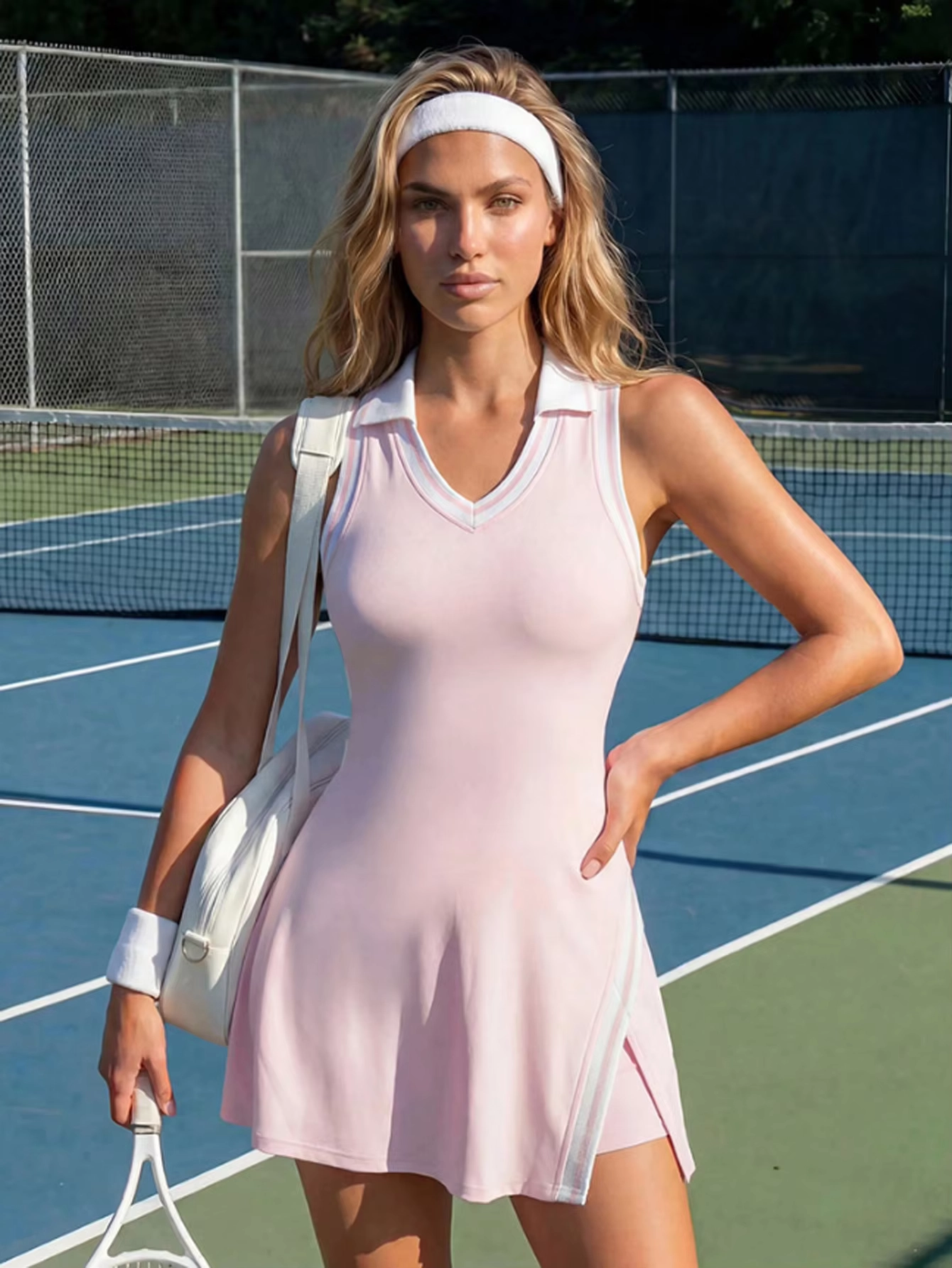
This is one reason tennis apparel occupies such an interesting position today. A tennis dress can be performance clothing, but it can also be someone’s first visual connection with the sport.
Sometimes participation follows identity rather than the other way around.
You do not always become a tennis player and then decide what a tennis player wears.
Sometimes you put on something that makes the court feel like a place you belong—and then you start playing.
Tennis Has Become Social Fitness
Modern consumers increasingly want exercise to provide more than physical output.
They want experiences.
Running clubs have demonstrated this clearly. Boutique fitness built entire businesses around community. Golf has increasingly positioned a day on the course as social leisure as much as competition.
Tennis naturally fits the same shift.
A session has built-in interaction.
Someone sends the message:
“Want to play tomorrow?”
You meet at the court.
You warm up.
You play.
You talk between points.
Maybe you stay afterward for coffee or lunch.
And then you arrange the next match.
Over time, the exercise becomes attached to relationships.
That is a powerful retention mechanism because the reason for showing up is no longer only:
I should exercise.
It becomes:
My friend is waiting for me.
This helps explain why the rise in core players is arguably more meaningful than the headline participation number. When more than half of U.S. participants are playing ten or more times per year, tennis is becoming part of people’s routines rather than something they simply tried once. USTA
And those routines naturally create other behaviors around the sport: lessons, club memberships, court bookings, weekend plans, equipment purchases, travel—and apparel.
The Tennis Tournament Is Becoming a Cultural Event
The lifestyle shift is visible at the professional level too.
Look at what happened at the 2026 US Open.
More than 1.2 million people attended, making it the most highly attended US Open in history. More than 300,000 participated during Fan Week alone. Every ticketed event sold out. 美国网球公开赛
But what is particularly interesting is what those people were being invited to experience.
It wasn’t only tennis.
Fan Week included live music, DJs, podcasts, entertainment, food, family activities, interactive experiences and player practices. More than 250,000 people visited the separate US Open Experience at Hudson Yards, where tennis was presented alongside gaming, fitness, fashion, brand activations and entertainment. 美国网球公开赛
Digital engagement followed the same pattern.
US Open platforms attracted more than 12 million unique digital visitors in 2026 and generated more than 270 million engagements, up 16% from 2025. The tournament’s owned social channels recorded more than 3.9 billion interactions, an increase of 26%. 美国网球公开赛
This is what happens when a sport becomes culturally relevant beyond the result of the match.
People come for competition.
But they also come for atmosphere.
For fashion.
For food.
For friends.
For entertainment.
For content.
For the experience of being there.
Tennis is increasingly functioning as both sport and cultural platform.
And Tennis Clothing Is Leaving the Court
Perhaps nowhere is the lifestyle transformation more visible than in clothing.
Traditional tennis pieces—pleated skirts, dresses, polos, sweaters, visors and court shoes—have been repeatedly reinterpreted for everyday wardrobes.
The term tenniscore describes this crossover particularly well: the visual language of tennis combined with contemporary sportswear, preppy styling and relaxed everyday clothing.
Fashion forecasting and tennis retail coverage in recent years have documented tennis-inspired polos, pleated skirts, sweaters and other court references moving between performance apparel and streetwear. 网球仓库
That evolution changes what consumers expect from tennis clothing.
A player may still need performance characteristics such as freedom of movement, lightweight fabric and comfort during a match.
But she may also ask:
Can I wear this to lunch afterward?
Would I travel in it?
Does it feel good enough to wear even when I am not playing?
Does this look like me?
Modern tennis apparel increasingly has to answer both sets of questions.
Performance and lifestyle are no longer separate conversations.
Why This Matters for the Future of Tennis
The most important lesson in the 2026 numbers may be that tennis is growing in several dimensions at once.
There are more players.
They are playing more frequently.
Women are contributing strongly to growth.
Millions of beginners continue entering the sport.
Major tournaments are generating record attendance and cultural engagement.
And tennis aesthetics remain visible far beyond the court.
None of those trends alone would prove that tennis has become a lifestyle sport.
Together, they tell a much stronger story.
Tennis is increasingly becoming something people do, wear, watch, share and build relationships around.
That gives the sport an advantage.
You can arrive because you want exercise and stay because you found friends.
You can arrive because you love the competition and discover a community.
You can discover the sport through a tournament, a player, a social post—or even a tennis dress you simply wanted an excuse to wear.
Eventually, all those entry points lead to the same place:
the court.
And that may be the clearest definition of tennis as a lifestyle sport.
It no longer has to be the center of someone’s life to become part of the way they live it.